
Every parent needs to take care of their baby’s health. Therefore, having a baby thermometer is a must. But as much as it is vital to have a thermometer, measuring the baby’s temperature accurately is also necessary. Here are the steps and necessary precautions on how to measure a baby’s temperature.
Steps To Measure A Baby’s Temperature With a Thermometer
1) Oral Temperature
First and foremost, turn on the digital thermometer and wipe off any excess dirt. Then, place the tip of the thermometer (the thin part) under the tongue of your baby. Be careful as babies might shake a lot, making sure it is under the tongue touching the wall. Also, make sure that lips are closed while you measure. Place the thermometer for about a minute to get accurate readings. If your baby recently had food, then it is preferable.
2) Armpit Temperature
For taking the armpit temperature, you have to make sure that you’ve turned on the thermometer and the tip of the thermometer touches the armpit skin and not the sleeves. Just put it under the arms and keep the arm close till the thermometer reads the temperature.
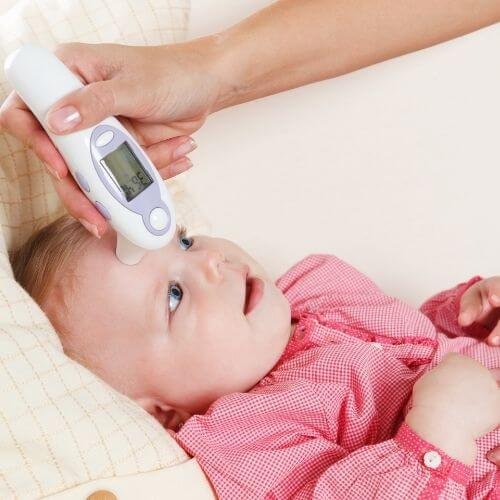
How to Measure a Baby’s Temperature
3) Ear Temperature
To measure the ear temperature, you’ll need an ear thermometer:
Please read the instructions thoroughly before using them, as it may have any unique feature or an important points you have to keep in mind before using it.
Important Points For Ear Temperature
- You have to check the baby’s ear, if there is too much wax, then the thermometer won’t be able to read the exact temperature, and you have to opt for some thermometer.
If you think the baby has some infection or fever due to the ear infection, do not proceed. - Ensure that you clean the thermometer’s tip with a clean cloth and put it on the disposable probe cover.
- Pull the ear lob down and back and gently wiggle the thermometer into the ear. Please don’t push it forcefully and maintain the distance from the ear canal.
- You will hear a beep sound once it reads the temperature. The average temperature is 99.5 F degrees. Seek medical assistance if the reading exceeds 103 or less than 95.
4) Temporary Artery Temperature
For this method, you have to sweep the thermometer gently on the forehead. Remove the thermometer and read the temperature.
Do’s
- Keep your child still and in-room temperature while you take the reading.
- Don’t take the temperature of different parts of the body each time.
- Thoroughly read all the instructions.
- Know the average temperature for each part of the body.
- Keep a good check on your baby’s health.
Dont’s
- Don’t take temperature just after your child has their food. Take the reading after 20-30 mins.
- Don’t use forehead thermometers on infants under three months.
- It is not preferable to use mercury or alcohol thermometers. If they break, they can cause injury or poisoning.
- Don’t use strip-type thermometers; they’re usually inaccurate.
Types of Thermometers
Mercury/ Alcoholic Thermometers:
- They give you reading in an analogue form.
- It works in a good way for a very long period.
- There is a risk of injury if the thermometer breaks, and it can be poisoning.
Digital Thermometer:
- They give you reading in a digital form.
- They can run out of battery.
- No such risks while using a digital thermometer.
- The digital thermometer is not only faster
Temperature Difference in Different Parts of Body
- Ear: 0.3°C to 0.6°C higher than oral
- Armpit: 0.3°C to 0.6°C lower than oral
- Forehead: 0.3°C to 0.6°C lower than oral
Age Guideline
- 0-3 months: rectal/armpit thermometer
- 3 months-4years: rectal/armpit/ear thermometer
- Four years older: oral thermometer
Conclusion
It would help if you were very careful while determining the baby’s temperature and take all necessary precautions.


![Are Baby Swings Dangerous? [Find Out Now][Latest Research]](https://kidzya.com/wp-content/uploads/thumbs_dir/Are-Baby-Swings-Dangerous-1yo6e2tum7006wxh9ffmt6ud4ww0fjepjuqmwn5xd12c.jpg)
![Are Baby pillows safe? [Find Out Now With A Must Checklist]](https://kidzya.com/wp-content/uploads/thumbs_dir/Are-Baby-pillows-safe-1yn372h96f8yqsd4fbnkm0kijudn6dv5zhhfwejyilk4.jpg)